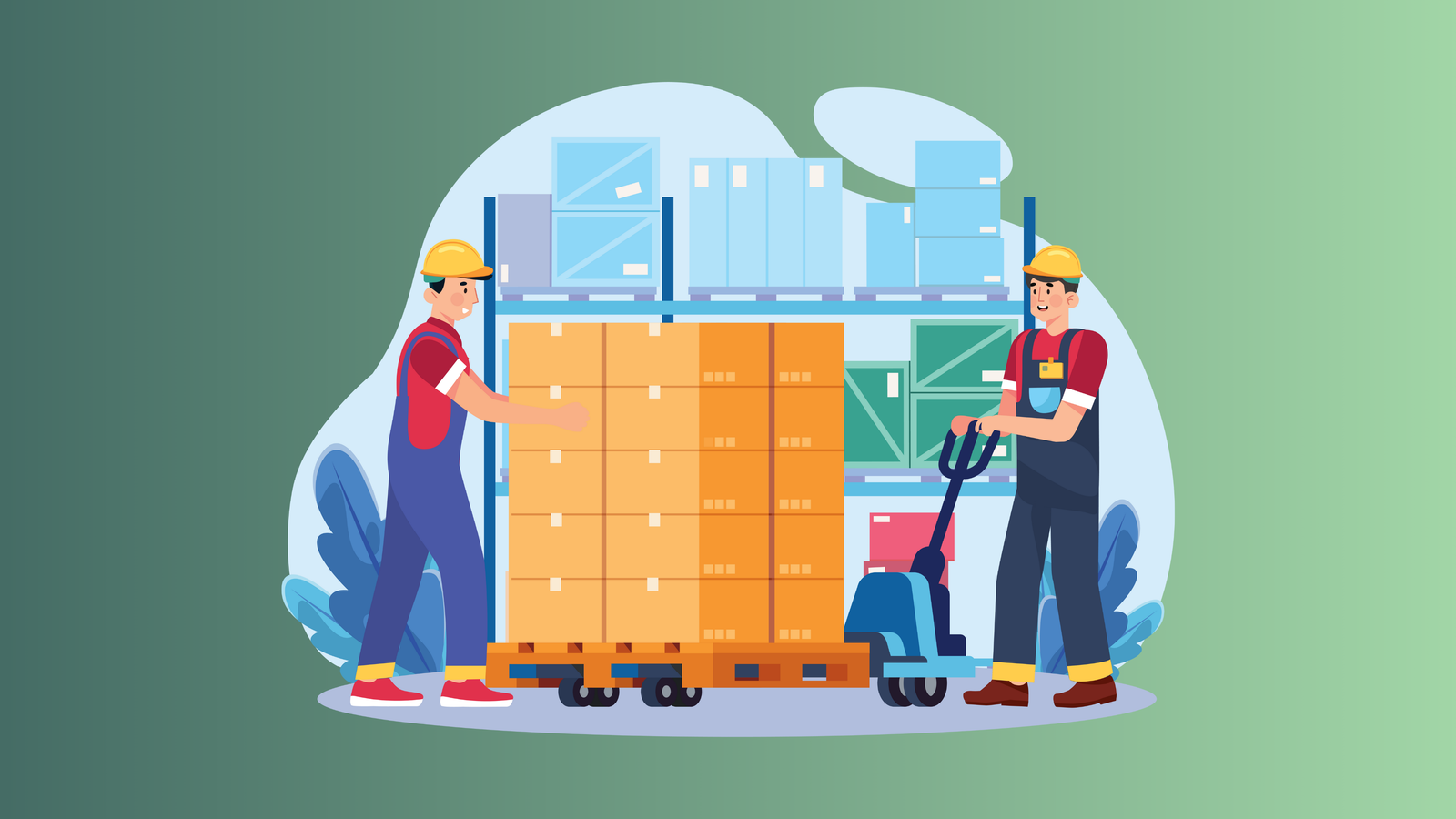
1. Truck Math: The Pallet Capacity
A standard 26ft box truck (like those from Penske or Enterprise) has a floor length of 312 inches and a typical interior width of 96 to 102 inches.
Using standard 48" x 40" GMA pallets, your capacity depends on your orientation:
*Warning: Double stacking is only possible if your product is not "crush-prone" and your total weight stays under the payload limit (typically 10,000 lbs for non-CDL trucks).
2. Stacking Logic: Column vs. Interlock
Choosing the wrong pattern is the #1 cause of transit damage. In 2026, the industry has standardized these two methods:
-
Column Stacking (Best for Strength): Boxes are stacked directly on top of each other, corner-to-corner. Since the corners are the strongest part of a box, this provides 25-30% more compression strength.
-
Risk: Unstable. These pallets must be wrapped tightly to prevent "totem-poling."
-
-
Interlock / Brick Stacking (Best for Stability): Rotating each layer like bricks in a wall. This creates a self-supporting unit.
-
Risk: Reduced strength. Placing a corner of a top box on the center of a bottom box can lead to the "sickening crunch" of a collapse.
-
Pro Tip: For mixed loads, use Column Stacking for the bottom 3 layers (foundation) and Interlock the top 2 layers to "tie" the pallet together.
3. The 2026 Amazon FBA Standard
If your 26ft truck is headed to an Amazon Fulfillment Center, compliance is stricter than ever.
-
Height Limit: Standard pallets cannot exceed 72 inches (including the pallet base).
-
Overhang: Amazon and most LTL carriers will reject pallets where boxes hang over the edge. Overhang reduces box strength by 30% and leads to "bump damage" from forklifts.
-
Double Stacking: Amazon allows double stacking only if the combined height is under 100 inches and the total weight is under 1,500 lbs.
4. Maximizing Throughput with Closo
Once your truck is loaded (or unloaded), the next bottleneck is data.
-
Sourcing: Use Closo Wholesale to find inventory that is already palletized to GMA standards, reducing your prep time.
-
Processing: When that 14-pallet truck hits your dock, use the Closo 100% Free Crosslister. Instead of manually typing 500 SKUs, scan the barcodes to pull descriptions and images instantly.
-
Demand Intelligence: Use Closo Demand Signals to decide which pallets to prioritize. If the data shows a spike in "Air Fryers" in your region, unload that pallet first to catch the market high.
1. The Anatomy of a Perfect Pallet
When people search for boxes on pallets, they often visualize a messy pile of cardboard wrapped in plastic. But in the professional world, a pallet is a standardized unit of commerce. If you build it wrong, carriers will refuse it. If you stack it wrong, it will collapse.
Choosing the Right Base
Everything starts with the wood.
-
Standard GMA Pallet (48" x 40"): This is the gold standard in North America. It fits perfectly two-wide in a standard trailer.
-
Euro Pallet (1200mm x 800mm): Common if you are importing, but they don't fit as efficiently in US trucks.
-
Plastic vs. Wood: Wood is cheaper and repairable. Plastic is hygienic and doesn't require heat treatment for international shipping.
Honest Failure: I once tried to save money by using "free" pallets I found behind a grocery store. They were non-standard sizes—some 48x48, some 42x42. When the LTL (Less Than Truckload) driver arrived, he took one look and refused the pickup. "I can't play Tetris with these," he said. "They won't fit side-by-side." I had to restack 12 pallets in 90-degree heat.
-
Lesson: Stick to 48x40 GMA pallets.
The "Overhang" Sin
Never let your boxes hang over the edge of the pallet. Cardboard box on pallet overhang reduces the box's compression strength by up to 30%. Plus, when forklifts push pallets together, the bumpers will crush your inventory instead of hitting the wood. Always aim for "Underhang"—keep the boxes 1 inch inside the perimeter.
I use Closo Wholesale to source inventory that comes in standardized case packs—saves me about 3 hours weekly of trying to puzzle-piece odd-shaped boxes together.
2. How to Stack Boxes on a Pallet (The Physics)
There are two main schools of thought on how to stack boxes on a pallet, and people fight about them in warehouse breakrooms.
Method A: Column Stacking
You stack the boxes directly on top of each other, corner-to-corner.
-
Pros: Maximum strength. The corners of a box are the strongest part. By aligning them, the weight transfers straight down to the wood.
-
Cons: Unstable. The columns can separate and topple like Jenga towers if not wrapped tightly.
-
Best For: Heavy items, uniform case packs, and situations where compression damage is a risk.
Method B: Interlocking (Brick) Stacking
You rotate the boxes each layer, like laying bricks.
-
Pros: Maximum stability. The stack holds itself together.
-
Cons: reduced strength. You are placing the corner of a top box onto the middle (weakest point) of the bottom box.
-
Best For: Lighter items, mixed SKUs, and loads that need to survive bumpy roads.
Here's where it gets interesting... The hybrid approach is often best. Stack the bottom 2-3 layers in columns to build a strong foundation. Then, interlock the top layers to "tie" the load together. (Use a cardboard slip sheet between the transition layers to prevent the corners from digging in.)
3. Truck Math: How Many Pallets Fit on a Box Truck?
This is the most common question in logistics: how many pallets fit on a box truck? The answer depends on your loading pattern and the width of the truck. Let's assume a standard 26ft box truck (like a Penske or U-Haul) and standard 48x40 pallets.
The "Straight" Load (Lengthwise)
You load the pallets with the 48-inch side running parallel to the truck's length.
-
Math: 26 feet = 312 inches.
-
Calculation: 312" / 48" = 6.5.
-
Result: You can fit 6 rows.
-
Total: Since the truck is wide enough for two pallets side-by-side, you fit 12 pallets.
The "Pinwheel" Load (Sideways)
If your truck is a "wide body" (102 inches wide), you can turn the pallets sideways (40-inch side parallel to length).
-
Math: 312" / 40" = 7.8.
-
Calculation: You can almost fit 8 rows. Usually, you can fit 7 rows comfortably.
-
Result: 7 rows x 2 = 14 pallets.
Opinion Statement: If you are renting a consumer truck (like U-Haul), assume the walls are thick and the door is narrow. Stick to the conservative estimate of 12 pallets. Don't try to be a hero and squeeze 14, or you'll end up leaving two on the loading dock.
4. How Many Pallets Can Fit on a 26ft Box Truck (Double Stacked)?
Now, how many pallets can fit on a 26ft box truck if you go vertical? Most 26ft trucks have a height clearance of roughly 96 to 102 inches. A standard pallet is roughly 6 inches tall. If your stacked boxes are 40 inches high:
-
Total pallet height = 46 inches.
-
Two pallets high = 92 inches.
The Answer: You can theoretically fit 24 to 28 pallets if you double stack. The Catch:
-
Weight: A 26ft truck usually has a payload capacity of around 10,000 lbs. If your pallets weigh 1,000 lbs each, you can only carry 10. You will hit the weight limit long before you hit the volume limit.
-
Crush Risk: Can your bottom pallets support 1,000 lbs sitting on top of them?
My Anecdote: I double-stacked a load of "Returned Air Fryers." They seemed sturdy. By the time I drove from Ohio to Kentucky, the bottom layer had collapsed. It looked like the Leaning Tower of Pisa made of cardboard. I spent 4 hours restacking them inside the hot truck before the receiver would let me unload.
5. Types of Pallet Boxes and Bulk Containers
Sometimes, stacking individual boxes is a nightmare. Enter the shipping pallet box, also known as a Gaylord.
The Gaylord Box
This is a giant corrugated box that fits perfectly on a 40x48 pallet.
-
Dimensions: Typically 48" x 40" x 36" (or 48").
-
Capacity: Can hold 1,000+ lbs of loose items.
-
Best For: Loose clothing, uneven items, or "dump bins."
When to Use Pallet Boxes
If you are using Closo Crosslister to process hundreds of small items (like phone cases or books), don't box them individually. Throw them all in a Gaylord. It saves hours of taping. Then, wrap the Gaylord to the pallet so it doesn't slide off.
I use Closo Demand Signals to decide if a pile of loose inventory is worth the cost of a Gaylord box (which can cost $20-$30 each). If the demand is low, I donate it. If the demand is high, I box it and ship it.
6. Securing the Load: Wrap, Strap, and Pray
You have stacked your boxes on pallet. Now you have to secure them. Gravity is not your friend. Centrifugal force is your enemy.
The Shrink Wrap Art Form
-
The Knot: Tie the plastic to the pallet wood first.
-
The Base: Wrap the bottom (wood and first layer of boxes) at least 4 times. This anchors the load.
-
The Climb: Work your way up, overlapping by 50%.
-
The Top: Wrap the top layer 3 times.
-
The X-Pattern: For heavy loads, twist the wrap into a "rope" and pull it diagonally across the pallet for structural tension.
Corner Guards (Edge Protectors)
These are L-shaped cardboard strips that run up the corners of your stack. They serve two purposes:
-
They prevent the shrink wrap from crushing the corners of your boxes.
-
They turn your individual boxes into a solid "unit," massively increasing stability.
-
Cost: ~$1 per strip.
-
Value: Priceless.
7. Pallet Stacking Patterns for Odd Shapes
Not every box is a perfect 12x12 cube. Pallet stacking patterns get tricky when you have mixed inventory.
The Pyramid (Don't Do It)
Beginners often stack smaller boxes on top, creating a pyramid. Why it fails: It is unstable. The top boxes fly off when you brake. The Fix: Use "chimney stacking" for the center or use a Gaylord. Or, create a flat layer of larger boxes, place a slip sheet, and start a new layer of smaller boxes.
The "Chimney"
If you have a gap in the middle of your pallet, leave it. Stack the boxes around the perimeter (this aligns with the strongest part of the pallet). You can fill the "chimney" (the hollow center) with loose items or dunnage air bags to keep the outer ring tight.
8. Weight Distribution: The Silent Killer
You know how many pallets fit on a box truck (12-14). But can the truck handle it? A 26ft Non-CDL truck usually has a Gross Vehicle Weight Rating (GVWR) of 26,000 lbs. The truck itself weighs about 16,000 lbs empty. That leaves you with 10,000 lbs of payload.
The Math:
-
12 pallets x 1,000 lbs = 12,000 lbs. OVERWEIGHT.
-
You might fit the volume, but you are illegal on the scales.
-
If the DOT pulls you over, they will make you unload 2,000 lbs on the side of the highway. (I have seen this happen. It is tragic).
Now the tricky part... Axle weight. You can't put all the heavy pallets near the cab and the light ones near the tail. You need to distribute the weight evenly. Put the heaviest pallets over the rear axle. Put medium weight in the nose.
9. Tools of the Trade
You can't do this with bare hands.
-
Pallet Jack: Essential. If the destination doesn't have a forklift, you need a pallet jack to move the items to the tail of the truck.
-
Scale: A floor scale to weigh each pallet before loading.
-
Tape Measure: To check for "Overhang."
-
Closo Wholesale: To source inventory that is already palletized correctly.
10. From Pallet to Profit: Processing the Boxes
Once the pallet with boxes arrives at your warehouse (or garage), the clock starts ticking. A pallet sitting on the floor costs you money (storage). A pallet listed online makes you money.
The Workflow:
-
Cut the Wrap: Be careful not to slice the boxes.
-
Sort: Use the "Three Bin Method" (List, Fix, Trash).
-
Cross-List: Use Closo Crosslister to scan the UPCs on the boxes.
-
It pulls the product data.
-
It pushes the listing to eBay, Mercari, and Poshmark.
-
You can process a pallet of 500 items in a single day using automation.
-
I use Closo to automate listing the contents of mixed pallets – saves me about 3 hours weekly of manual data entry.
11. FAQ: Common Pallet Questions
People always ask me: Can I reuse pallets?
Yes, but inspect them. Look for the "HT" stamp (Heat Treated). If a pallet has a "MB" stamp (Methyl Bromide), it is chemically treated. Do not use it. It is toxic. Also, check for "Blue" or "Red" pallets (CHEP/PECO). These are rental pallets owned by large pools. Technically, you are supposed to return them. If you ship on them, the receiver might charge you a fee. Stick to standard white wood stringer pallets.
Common question I see: What is the max height for a pallet?
Standard LTL carriers usually cap you at 96 inches (8 feet) because that is the door height. However, for stability, try to keep it under 72 inches (6 feet). If you go higher, the center of gravity gets too high, and it will tip. Also, Amazon FBA has a strict limit of 72 inches (unless it's a single unit). If you send a 90-inch pallet to Amazon, they will reject it.
12. Honest Limitations of Pallet Shipping
Shipping via pallet (LTL) is cheaper per unit than UPS Ground, but it has headaches.
-
Lift Gate Fees: If you don't have a dock, you pay ~$50 extra for a lift gate.
-
Appointment Fees: If you deliver to a residential address, they charge extra.
-
Damages: Forklifts puncture boxes. It happens. Always insure your load.
Opinion Statement: If you are shipping less than 150 lbs, just use UPS/FedEx Ground. If you are shipping more than 150 lbs, build a pallet. The break-even point is usually around 200-300 lbs.
13. Advanced Stacking: The "Ti-Hi" Concept
In logistics, we talk about Ti-Hi.
-
Ti (Tier): The number of boxes in a single layer.
-
Hi (High): The number of layers high.
-
Total Boxes: Ti x Hi.
Example: You have boxes that are 12" x 10". You can fit 16 boxes per layer on a 48x40 pallet (Ti = 16). You can stack them 5 high (Hi = 5). Total boxes = 80.
Knowing your Ti-Hi allows you to calculate how many boxes on a pallet instantly without counting.
Conclusion
Mastering the logic of boxes on pallet is the difference between an amateur flipper and a logistics professional. It allows you to move volume. It allows you to buy from Closo Wholesale in bulk. And it allows you to sleep at night knowing your inventory won't arrive at the destination looking like a crushed soda can.
Remember:
-
No overhang.
-
Interlock your layers.
-
Wrap it like a mummy.
-
Don't overload the truck axles.
Get the physics right, and the profits will follow.
Start cross-listing with Closo today—because once you unload that truck, you're going to need to list those thousands of items fast.